தொழில்நுட்பம் & AI
🤖தொழில்நுட்பம் & AI

The Awakening: When AI Forces Humanity to Unlock Its True Mind

Rajeswaran Thangeswaran··7 நிமிட வாசிப்பு·
#artificial-intelligence#human-brain#consciousness#future#evolution#neuroscience
The Awakening: When AI Forces Humanity to Unlock Its True Mind

The Quiet Revolution No One Is Talking About

There's a moment in every chess game where the board changes. Not because someone made a brilliant move — but because one side ran out of safe squares. That's where humanity stands right now.

AI writes our emails. It drives our cars. It diagnoses diseases, composes music, generates art, and codes software — often better and faster than we can. Every month, another headline announces something AI has "mastered." And every month, the same anxious question echoes: What's left for us?

But here's the thing nobody is asking: What happens to the human mind when it's no longer needed for routine survival?

I believe something extraordinary is about to happen. Not the extinction of human relevance — but its evolution.

The Myth We Believed Too Long

For decades, we built our identities around what we produce. Your worth was your output — reports filed, hours clocked, widgets assembled. The entire education system was designed to create reliable workers: memorize, repeat, comply.

And in that process, we put our most powerful organ — the brain — on a leash.

Think about it. How much of your day involves genuine, deep thought? Not reacting to notifications. Not scrolling. Not repeating patterns you learned years ago. How often do you sit with a problem so deeply that time disappears and new connections form in your mind like lightning across a dark sky?

For most of us, almost never.

We've been running the most advanced biological computer ever created on the equivalent of safe mode. Not because we're incapable — but because the world never demanded more.

Until now.

The Lucy Hypothesis

In the film Lucy, Scarlett Johansson's character gains access to progressively larger percentages of her brain capacity. At 20%, she can control her own body at the cellular level. At 40%, she manipulates matter. At 100%, she transcends space and time itself.

It's science fiction, of course. The "we only use 10% of our brain" claim is a myth in the literal neurological sense — we use all regions of our brain. But there's a deeper truth buried in that myth that neuroscience actually supports:

We use almost none of our brain's potential.

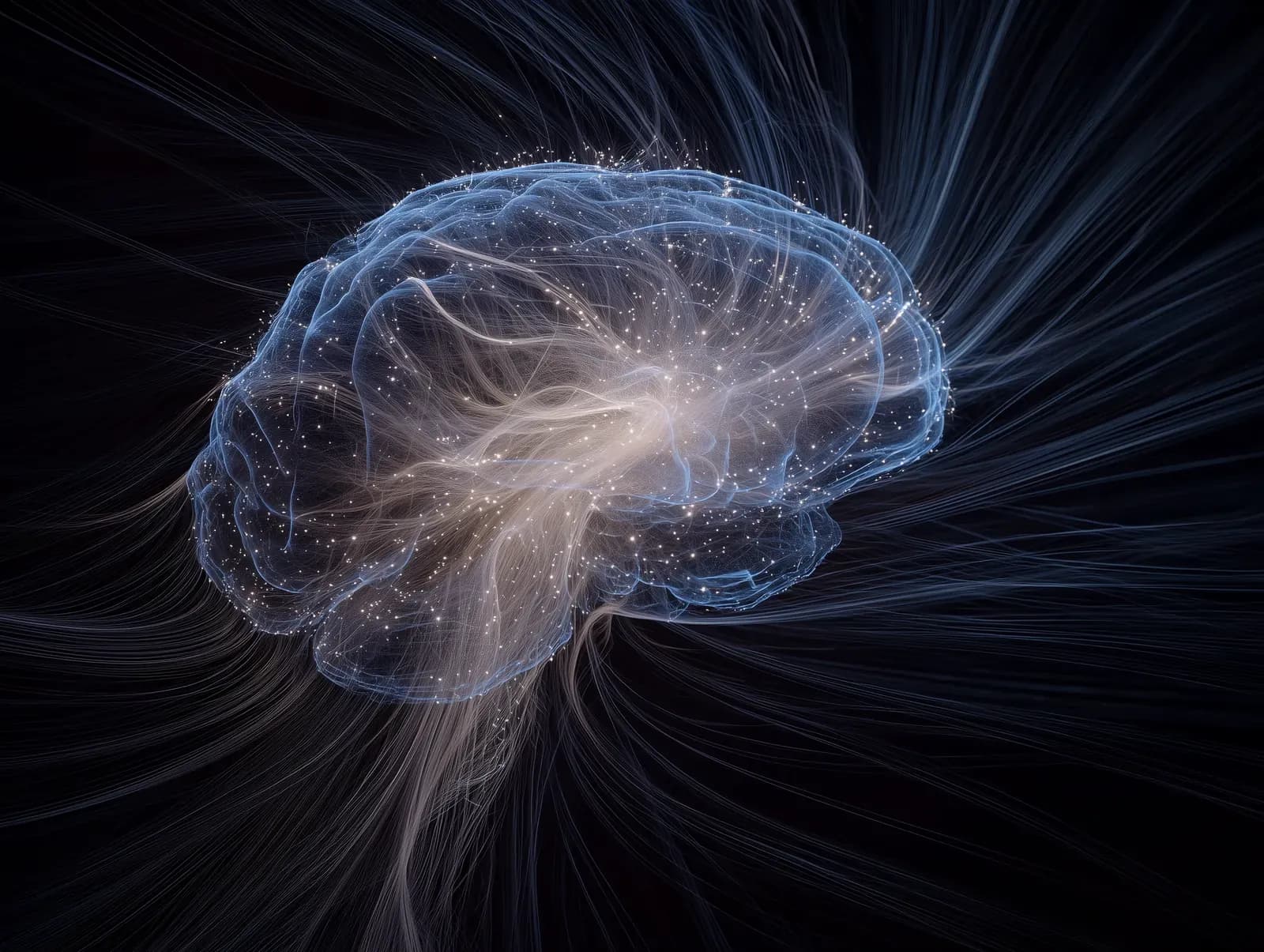
The average human brain has roughly 86 billion neurons, each capable of forming thousands of connections. That's more possible neural pathways than there are stars in the observable universe. Yet most of us spend our days activating the same tiny loops — the same routines, the same reactions, the same narrow band of thought.

What if AI is the trigger that forces us off those well-worn paths?

The Pressure Principle

Nature has a brutal but effective teacher: pressure.

When oxygen levels dropped in ancient oceans, life didn't just die — it evolved lungs. When ice ages froze the savanna, early humans didn't just perish — they developed abstract thinking, language, and tool-making. Every great leap in biological capability was born from a crisis that made the old way of surviving impossible.

AI is that crisis for the human mind.

Not a crisis of destruction — but a crisis of irrelevance. When a machine can do in seconds what took you days, you face a choice: become obsolete, or become something the machine cannot be.

And here's what machines cannot be: conscious, intuitive, spiritually aware, creatively irrational, deeply empathetic, and wildly imaginative all at the same time.

What the Awakened Mind Looks Like

I believe we're about to witness a cognitive renaissance — not in labs or universities, but in ordinary people who are forced to dig deeper into what makes them human.

Stage 1: The Discomfort — Millions lose routine jobs. Anxiety peaks. Identity crises spread. This is the oxygen leaving the ocean.

Stage 2: The Seeking — People begin exploring what no algorithm can replicate: meditation, deep creativity, philosophy, spiritual inquiry, psychedelic research, consciousness studies. Not as hobbies — as survival strategies.

Stage 3: The Expansion — Neural pathways that lay dormant for generations begin firing. Humans develop heightened intuition, pattern recognition beyond logic, creative synthesis that machines cannot model because it's rooted in lived experience and emotion.

Stage 4: The Symbiosis — Humans don't compete with AI. They partner with it. AI handles computation, data, and repetition. Humans handle meaning, purpose, ethics, beauty, and the questions that have no data-driven answers: Why are we here? What should we build? What is worth preserving?

The Brain Is a Muscle We Forgot to Exercise

Here's something neuroscience has proven: the brain physically restructures itself based on how you use it. London taxi drivers who memorize thousands of streets develop a measurably larger hippocampus. Musicians who practice daily develop denser neural connections in motor and auditory regions. Meditators show increased grey matter in areas linked to self-awareness and compassion.

Neuroplasticity is real. Your brain is not fixed. It's waiting.

Now imagine an entire generation — billions of people — suddenly freed from repetitive mental labor. What if instead of scrolling through AI-generated content, they started creating in ways they never had time for? What if instead of memorizing facts (which AI knows better), they started asking questions no one has ever asked?

The brain, under the right pressure and with the right freedom, doesn't just adapt. It transforms.

What Humans Might See

If we truly unlock deeper cognitive engagement, what becomes possible?

Perception beyond the visible — Our brains already filter out 99% of sensory information to keep us focused on survival. What if, freed from survival-mode thinking, we begin perceiving patterns in reality that were always there but invisible to our distracted minds? Quantum physicists already suspect consciousness plays a role in the nature of reality itself.

Intuition as intelligence — We've dismissed gut feelings as unscientific. But research shows intuition is the brain's ability to process millions of data points below conscious awareness and deliver a conclusion as a "feeling." What if we learned to trust and refine that ability?

Collective consciousness — The internet connected our devices. What if the next leap connects our minds? Not through technology — but through a shared depth of awareness that emerges when billions of humans are simultaneously engaged in deep, purposeful thought?

This isn't fantasy. This is the logical extension of what happens when the most adaptable species in Earth's history faces its greatest evolutionary pressure.

The Beautiful Paradox

Here's the irony that makes me smile every time I think about it:

AI — the thing we built to think for us — might be the very thing that forces us to finally think for ourselves.

Not to compete with machines on their terms. Not to process data faster or memorize more. But to go where no algorithm can follow: into the uncharted territory of human consciousness itself.

The robots aren't coming to replace us. They're coming to wake us up.

And when 8 billion minds wake up — truly wake up — the world won't just change.

It will become something we don't yet have the language to describe.

---

The future doesn't belong to AI. It doesn't belong to humans either. It belongs to the version of humanity that AI forces us to become.

---

This article reflects personal perspectives and philosophical exploration. The neuroscience references are simplified for accessibility.