
சிறுகதைகள்
✍️சிறுகதைகள்

The Language of Leaves

Rajeswaran Thangeswaran··11 நிமிட வாசிப்பு·
#short-story#fiction#plants#mental-health#science#usa
The Language of Leaves

Let me tell you about November in Redmond. The sun here is basically a rumour. Eight in the morning and the sky is still the colour of wet cement, a thin drizzle coming down like it has nothing better to do. They call Washington the Evergreen State. And sure, all that green is out there — soaking in the rain, minding its own business. Mahesh's green was different. His green lived indoors. Inside one room.

His home office was a small jungle. He was a software engineer at some IT company, the kind who started working from home during Covid and never really stopped. Slowly, one plant at a time, he had filled that room. Fifteen plants now, maybe more. Every morning, before his first meeting, he'd say good morning to each of them by name. On the heavy days — you know the ones, when there's a stone sitting on your chest and you can't tell anybody at home — he'd tell the plants instead. Quietly. And when he finished, it always felt like a small breeze came from somewhere and touched his face. Like they'd heard him. Anyone watching would've thought he'd lost it. He genuinely did not care.

---

His favourite was a prayer plant. It grew in a glass jar — no soil, just water and a few pebbles. Silver-green stripes on top, deep purple underneath. But the name didn't come from the leaves. It came from the habit.

Every evening, as the sun went down, that plant slowly lifted all its leaves, pulled them together, and folded them up — like two hands joining in prayer. All night it stood like that, praying. Then morning came, the sun came, and it opened up again, spreading its leaves out to face the world. Mahesh watched this with his own eyes, every single day. A plant that opens its hands in the morning and folds them at night. Every morning he saw it do this, something in him believed — today, something is going to be okay.

In the bedroom, a snake plant. Leaves like sword blades, standing dead straight, striped green and yellow like snakeskin. That was a fighter's posture. All the other plants leaned toward the light, begging for it — the snake plant leaned toward nobody. It just stood there, tall, on its own terms. Mahesh kept it in the bedroom for a reason. Here's the thing: most plants on this planet give out oxygen only during the day and quietly take it back at night. The snake plant doesn't play that game. It releases oxygen at night too. A friend who breathes calmly while the whole world sleeps.

On the desk, right in the centre of everything, a little elephant bush. Small round green leaves, a thick juicy stem. It gets the name because elephants love to eat it in the African bush. His wife had given it to him for his birthday. "You're always looking after everything, everyone. This one's for you — it's a very tough plant, it won't die easily," she'd said, laughing as she handed it over. From that day, it sat at the centre of his desk.

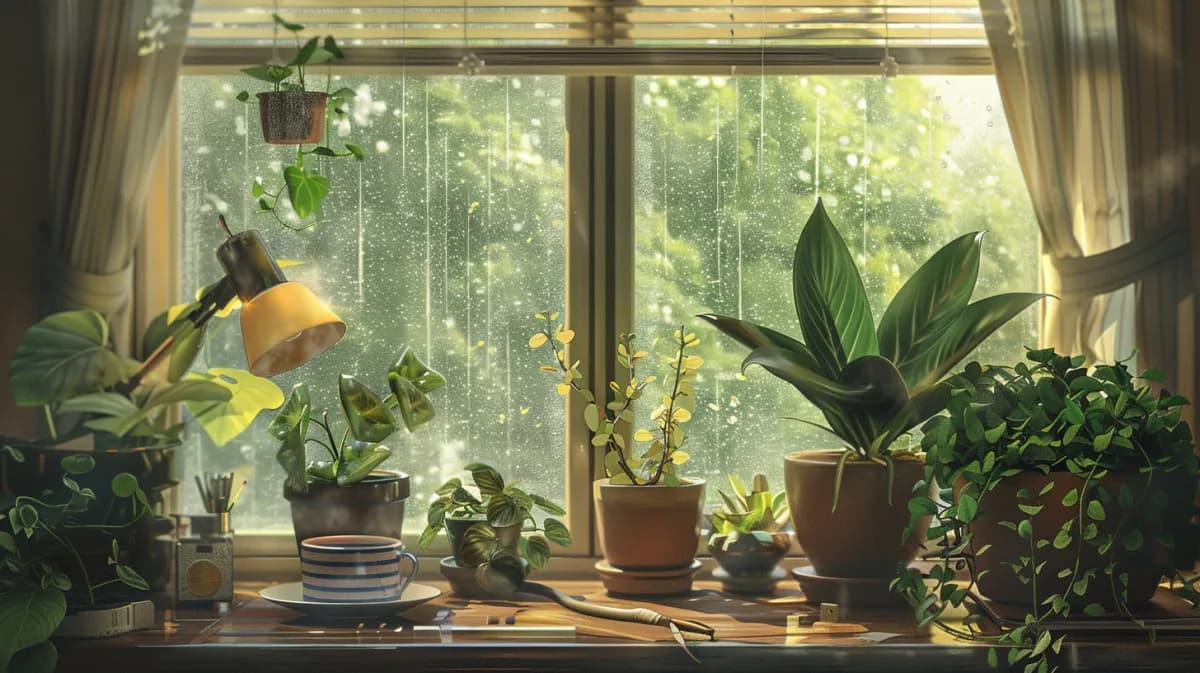
To one side, a desert rose. Its base swelled out like a pot — that's where it stores its water. Even with no water outside, it can live for months off its own reserve. It knows hard times are coming, so it stays ready. Nearby, a money tree with a braided trunk, and a jar of lucky bamboo — a quiet little wish for a certain piece of paper he'd been waiting years for. A red aglaonema, lighting up the dark winter corner. A ginseng bonsai with a knotted, sage-like root — every time he looked at it, one thought came: nothing beautiful is made in a hurry. And on the windowsill, a trailing pothos — the kind of friend who forgives your mistakes, who doesn't complain even when you forget to water it.

---

Mahesh believed the plants talked to him. Not in words. But if the prayer plant had its leaves open in the morning, good day ahead. A new leaf unfurling, good omen. If the plants drooped, his own heart drooped with them. He believed they were signalling something to him. At the same time, he also knew it was probably just his imagination. Both thoughts lived inside him together, side by side.

Then one night, around two in the morning, sleep nowhere in sight, he typed a question into his phone — do plants actually talk?

What he read shook him. Two years ago, in a university study, scientists put thirsty plants in front of microphones. And the plants — at a high frequency our ears can't reach — made sounds. Little clicks. Tick… tick… The less water they had, the more they were struggling, the more they clicked. Meaning: a plant, when it's thirsty, screams. Except that scream lives on a frequency the human ear can't touch. A living thing right next to you could be crying out in distress — and you'd never hear it.

He also learned that the prayer plant's movement was no miracle. At the base of each leaf is a tiny joint; water rises and falls inside it, so the leaf lifts and folds. It follows an internal clock — even without the sun, it keeps its own sense of time inside its body. The plant isn't praying. It's feeling the passage of time and moving with it. And knowing that, somehow, didn't make the movement any less beautiful to him.

The last thing he read hit closest to home. Our brains spent millions of years in forests and fields, and when we see green, they settle down on their own — heart rate drops, the stress hormone falls. Scientists have a name for it: biophilia, a natural love for living things. The plants might not speak in words, but the fact that his body calmed down near them was real. Not imagination. Biology. That night he slept peacefully. But that one line — a living thing could be screaming right beside you, and you won't hear it — stayed lodged in a corner of his mind.

---

Winter went deep. In December there were weeks he didn't see the sun at all. And in those long grey days, it happened at his company — layoffs. One morning meeting, and half his team was gone. Mahesh survived. But surviving didn't feel like relief. Today it was someone else; tomorrow? On top of that, the green card he'd been waiting ten years for still hadn't come. If the job went, could he even stay in the country?

He disappeared into that closed room. There was an understanding at home — on the heavy work days, don't disturb him. If the door was shut, that was his battlefield; nobody came in. He wanted that silence himself. But in those weeks the silence turned into a wall and rose up all around him.

Six in the morning to twelve at night, in front of that desk. He forgot to eat. Forgot to sleep. And a man who's forgotten to look at himself can't look at his room either. The watering stopped. The morning good-mornings stopped. Talking to the plants stopped — the one place that had always comforted him, he forgot it too.

The snake plant stood in its fighter's posture. The desert rose waited on its reserve. The lucky bamboo and the money tree, just like Mahesh, stood there hiding their thirst behind a smiling face.

But two plants couldn't hide it. The water in the prayer plant's jar dried up; it lost its sense of time and stood curled, not opening in the morning, not folding at night. And at the centre of the desk, his wife's elephant bush — its juicy leaves softening one by one, shrinking, starting to drop. That plant, on the high frequency no one can hear, was screaming its thirst. On the other side of the desk, Mahesh, on his own frequency no one could hear, was screaming his fear. Two voices in one room. And nobody was hearing either one.

---

One night — a week after the layoffs, around two in the morning — Mahesh couldn't sleep. The stone on his chest. A noise in his head, a restlessness that wouldn't settle. And he did what he always did on nights like this — got out of bed, went into the home office, went to his plants. To talk to them, to feel that breeze, that comfort, one more time.

He switched on the light. And there, in the very place he'd come looking for comfort, right in front of his eyes — the curled prayer plant, and his wife's elephant bush, dropping its leaves, dying.

He just stood there. The ones he'd come to for comfort had been waiting for him all those days, going without water, screaming on that frequency he couldn't hear. He had hidden his own struggle; the plants didn't know how to hide, so they'd written their struggle right onto their bodies. He and those plants shared the same season — both in the same room, unable to hear each other, each suffering alone.

---

At two in the morning he walked to the kitchen, brought back clean water, filled the jar, gently wet the elephant bush's soil. Then he sat down on the floor, in the middle of his plants. Rain outside. Light inside. And in between, after months, he talked to his plants again — this time to say sorry.

Plants don't change as fast as people. But that dawn, as he sat there, when the sun came up again, the curled prayer plant — very, very slowly — lifted one of its surviving leaves, just a little. Like it was reminding itself of its own clock again. It would take weeks to fully recover. But it had started to feel time again. Watching that faint movement, a truth dawned slowly inside Mahesh.

---

Those plants hadn't read his mind. They had no magic power. They did exactly one job — they didn't hide that they needed water, they showed it, plainly. That's all. But for as many days as those plants had gone thirsty, exactly that many days Mahesh had been starving himself. They didn't tell him his future; they showed him his present. The plants were a mirror. When he was okay, he looked after them, and they thrived; when he broke, he forgot them, and they wilted. In the days he forgot to look at himself, only those plants had honestly reflected his condition, curling up right there in front of him.

His belief all these years — that the plants were signalling something to him — wasn't wrong. But the signal was never about the future. It was about him. Their language was simply showing him himself.

---

From that day, Mahesh made a few small changes. Not big philosophies — small things. He bought a grow light for the plants and put it on a timer. Every morning he walked the room quietly for an hour, checking whether the prayer plant had opened its leaves. At noon he walked half an hour in Marymoor Park — real green, real rain-washed air. He made a rule: don't bring work to the dining table. The watering started again. And so did looking after himself.

His green card didn't show up overnight; the fear about the job didn't vanish in a single night either. The world doesn't change like that. But carrying that same fear, he learned again how to sleep, how to eat, how to breathe. Just like the desert rose stores water in its base before the hard times come, he learned to store a little quiet inside himself too.

---

One day in March, a rare thing happened in Redmond — a sun appeared. The sun that had hidden behind clouds for months poured a golden light through the window into the room that morning.

Mahesh walked in with his coffee. On the windowsill, in that sunlight, the prayer plant had spread its leaves fully open, palms stretched toward the sky. Beside it, his wife's elephant bush had pushed out a new, small, round leaf. The snake plant, the aglaonema, the money tree — all of them had turned toward that window.

Mahesh looked at them for a minute. Then he turned toward the window too, and stood there, taking the sunlight on his face.

He understood clearly now that plants don't speak in words. They cry out — in thirst, in distress — on a frequency we can't hear. He hadn't talked to them so they could answer back. But when he talked to them, inside that silent reply, he finally heard his own voice. Instead of hiding his struggle and quietly shrinking away, how to say it out loud — I need water — that's what those plants taught him. That's all. And that was enough.