
சிறுகதைகள்
✍️சிறுகதைகள்

The Fan

Rajeswaran Thangeswaran··6 நிமிட வாசிப்பு·
#short-story#fiction#nature#science#motherhood#sea
The Fan

Long before sunrise, Arumugam was already out on the water. A small fishing hamlet south of Nagapattinam. His boat, like him, was past sixty, rocking slow on the black pre-dawn sea. His wife had been gone five years; his children were in Chennai. What he had left for company was this sea, and a line of clay pots he'd sunk to the seabed below it.

Those pots were his net. The octopus is a strange fellow — it goes looking for dark little caves to hide in. Drop an empty clay pot on the sea floor and the octopus mistakes it for a crack in a rock, climbs inside, curls up, and settles down. Pull the rope, and up it comes with the pot. A trick the men of that hamlet have known for generations.

That morning most of the pots came up empty. Only the last one was heavy. Arumugam knew before he even landed it — something was inside.

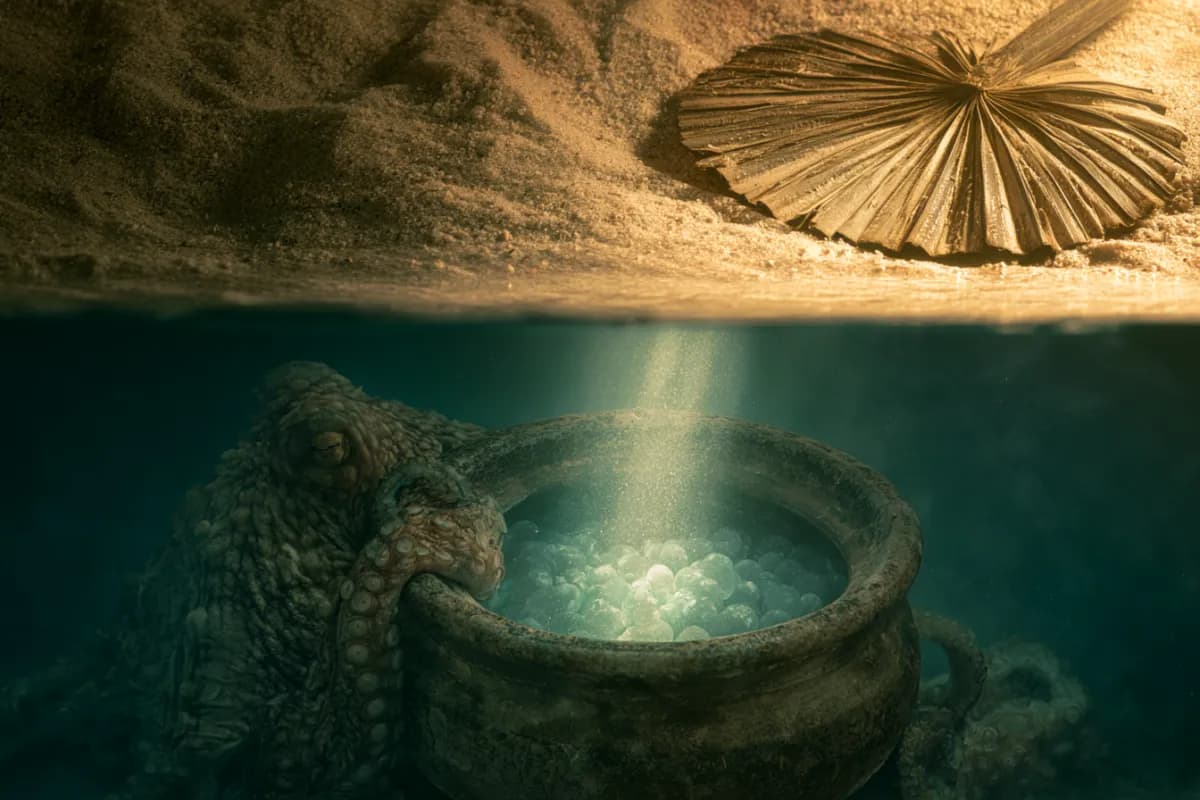
He tipped the pot into the boat. A big female octopus. But she didn't bolt. She didn't shoot her black ink. On the inner wall of the pot, glued in a cluster like a bunch of pearl beads, was a mass of eggs — and over them she had spread all eight of her arms, spread her whole body like a canopy, covering them. One eye watched Arumugam.

A good octopus fetches a good price at the town hotels. His hand went out to grab her and pull. But she didn't tighten to save herself — she tightened over the eggs. When his hand came near, she didn't flee for her life; she curled harder over them, hiding them. His hand stopped in mid-air.

He couldn't have told you why. In that one moment a night from fifty years ago rose up and stood in his mind. A summer night, no electricity. He was a small boy on a mat, and his mother sat at his head, fanning him with a palm-leaf fan so he could sleep. Every time he opened his eyes, she was still fanning. Sweat on her forehead; a cool breeze only for him.

That day he couldn't do it. Eggs, mother and all, he lowered the whole pot back into the sea — into the rock pool beside his hut, in a corner the waves didn't hit hard. "I'll take her after the eggs are gone," he told himself. From then on, every dawn, before heading out, he took to crouching at that pool and peering into the pot.

Old Sinnaiya, mending his net on the shore, noticed Arumugam checking the pool every single day. He said just one thing: "That's a sea-mother, appa. She won't eat one mouthful till the eggs hatch. Once they hatch, she's finished too. Every one of them, the same." That was all he said, then went back under his net.

The days moved on. Arumugam kept watching. That mother never once left the eggs. Through the funnel under her body she drew clean water and pushed it over the eggs, gently, gently, without stopping. With the tips of her arms she stroked each egg clean, picked off any speck that settled. Night and day, the one job — fan, clean, guard.

One day Arumugam dropped a live crab into the pot to test her. An octopus will take a crab, will eat it well — he knew that. But that mother didn't touch it. She didn't stir from the eggs. Next day, another crab; it too wandered the pool untouched. She was not eating. Not one bite.

That was when another memory came — and this time he didn't try to chase it away. When he was a small boy, the sea took his father. A storm night; the boat never came back. After that his mother raised him alone. On the days the fish were few, she'd put the fish on his plate and say, "I've already eaten." Only now did he understand that word was a lie. She hadn't eaten. Her plate was empty — and so he wouldn't see, she'd quietly wash it at the hearth.

Weeks passed. The mother's colour changed. The deep red-brown faded to grey. Her skin loosened and shrank; her arms thinned. And at the same time, tiny dots began to show inside the eggs — little eyes. One body was drying up and wasting; another whole swarm of life was opening up inside it. One grew at the price of the other.

His mother had dried up the same way, he remembered now. Year by year she thinned; year by year he grew. Her wrists wore down to bone; his shoulders broadened. She hid her hunger; he never once asked about it. Back then he hadn't understood. Crouched over this rock pool, fifty years too late, he understood.

---

One dawn, it happened. The eggs were ready. One by one they split, and hundreds of tiny octopuses — each the size of a grain of rice — burst out. Like sparks scattering underwater, they rose, spun, spread into the width of the sea, and in a few minutes were gone. Not one of them turned to look back.

That mother, with the last of her strength, pushed one hard jet of water through her funnel and sent the little ones off — one final fanning. Then she loosened the arms that had held the wall where the eggs had been. Dried, whitened, worn down to an empty husk, her body sank slowly to the bottom of the pool. She had not eaten one bite. She never saw even one of her young grow up. Nothing came back to her.

Arumugam lifted the lifeless body gently out of the pool. It lay in his palm as though it had no weight at all. He didn't sell her. He climbed into his boat, rowed far out from the shore — out to where the water goes deep — and gave the sea-mother back to the sea.

---

That night the heat was heavy. Sleep wouldn't come. He got up and took down his mother's old palm-leaf fan, the one that had hung on the wall all these years. All this time it had been just a fan.

He took it in his hand and waved it, once, softly. After all these years, for the first time, he felt the weight of that fan.