Quantum Tunneling: How Particles Walk Through Walls (And Why You Can't Teleport to Mars... Yet)

Imagine a Ball and a Hill
You roll a ball toward a hill. If it doesn't have enough energy to reach the top, it rolls back. Simple, right? That's how the everyday world works.
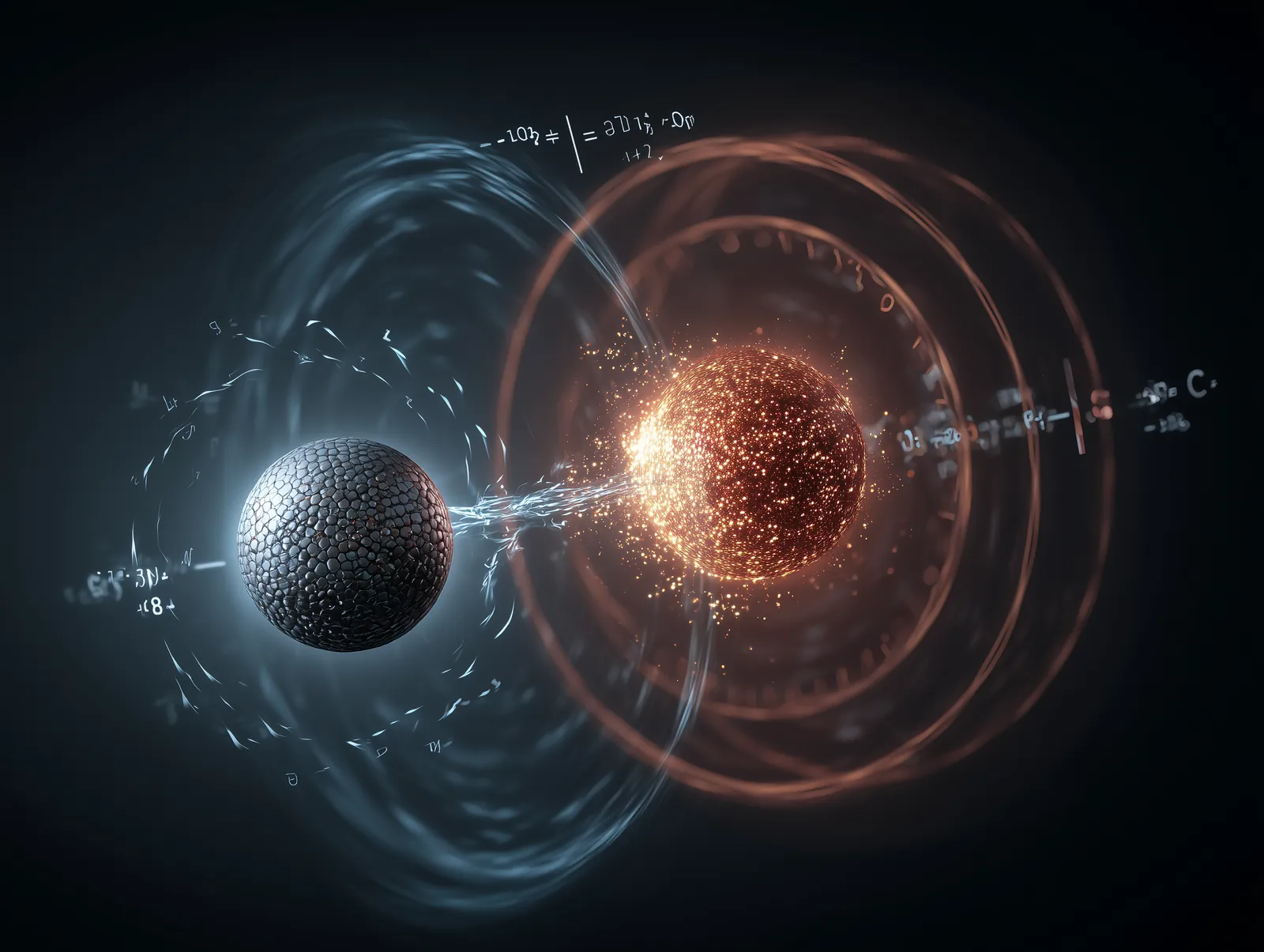
Now shrink that ball to the size of an electron. Something strange happens — the ball sometimes appears on the other side of the hill, even though it never had enough energy to climb over it. It didn't go over, it didn't go around. It went through.
This is quantum tunneling. And it's not a theory — it happens billions of times every second inside your body right now.
How Is This Possible?
In quantum mechanics, particles aren't solid little marbles. They behave like waves of probability. Think of it like this: if you throw a ball at a wall, you see a solid ball hitting a solid wall. But zoom into the quantum world, and that "ball" is more like a ripple in water.
When a wave hits a barrier, most of it bounces back — but a tiny bit of the wave leaks through to the other side. If the barrier is thin enough, enough of the wave makes it through, and the particle appears on the other side.
The particle doesn't "break through" the wall. It doesn't use some hidden energy. The math of quantum mechanics simply says: there is a non-zero probability of the particle being on the other side. And in quantum mechanics, if something can happen, it does.
Where Does This Actually Happen?
Quantum tunneling isn't just a lab curiosity. It's everywhere:
The Sun — The nuclear fusion powering our Sun relies on tunneling. Hydrogen nuclei don't have enough energy to overcome their electrical repulsion, but they tunnel through that barrier and fuse together. Without tunneling, the Sun wouldn't shine. Life wouldn't exist.
Your phone — Flash memory and transistors in modern chips use tunneling to store and process data. Every text you send involves quantum tunneling.
Radioactive decay — When an unstable atom emits a particle, that particle tunnels out of the nucleus. This is how we date ancient fossils and rocks.
Your DNA — Some research suggests that proton tunneling in DNA base pairs may contribute to genetic mutations. Quantum mechanics might literally be shaping evolution.
So Can Humans Tunnel to Mars?
Here's the question everyone wants answered. If an electron can tunnel through a barrier, could a human tunnel from Earth to Mars?
Technically, quantum mechanics doesn't say it's impossible. There is a probability of every particle in your body simultaneously tunneling to Mars. But let's look at the actual numbers.
The probability of a single particle tunneling through a barrier drops exponentially with the barrier's width and the particle's mass. A human body contains roughly 7 × 10²⁷ atoms. For all of them to tunnel simultaneously to Mars (about 225 million kilometers away), the probability is so unimaginably small that if you wrote it as a fraction, the denominator would have more digits than there are atoms in the observable universe.
To put it simply: you would need to wait longer than the age of the universe — not once, not a billion times, but a number of times so large that we don't have a name for it — for this to happen even once.
So mathematically? Not impossible. Practically? You're better off building a rocket.
Why This Still Matters
The beauty of quantum tunneling isn't that it will teleport us to Mars. It's what it tells us about reality: the universe doesn't work the way our everyday intuition says it should.
Solid walls aren't truly solid. Barriers aren't truly impassable. At the deepest level, reality is made of probabilities, not certainties. And sometimes, against all odds, things pass through walls.
There's something almost philosophical about that. The obstacles we see aren't always as absolute as they appear.
If quantum mechanics hasn't profoundly shocked you, you haven't understood it yet. — Niels Bohr