Everyone Glows

Twenty years ago, when I was twenty-two, I nearly drove my car off the East Coast Road on purpose.
I'm not proud of it. But that's where this story starts, so I have to tell you.
That night I hated my life. I won't bore you with the reasons — we all have our list, and mine felt very important at the time. I was driving fast on ECR, faster than I should have been, and some quiet part of me was hoping the car would just… solve the problem. One good crash. Done.
Then the radio played a song.
It wasn't a motivational song. It wasn't some big philosophy about how life is beautiful. It was just a love song — Ilaiyaraaja's own voice, a man telling the woman he loves that she is the one he'd been searching for all along. "Naan thedum sevanthi poo idhu." That's all. A simple love song.
But something in that tune walked straight into my chest and sat down. My foot came off the accelerator on its own. My eyes filled up. I didn't crash that night. I drove home. A love song saved my life — and it wasn't even trying to.
---
From that night, Ilaiyaraaja became the permanent background music of my life. Not one song — all of them. For twenty years, every single night, I fell asleep with one of his tunes in my ears. Didn't matter how bad the day had been or how late I got to bed. The music was always there on the pillow, next to my head.
But one question never left me. How? How can some vibrations in the air — just sound — change a man's mind like that? There has to be a connection between what we feel and some kind of energy we can't see. And if it's real, I thought, can it be measured?
That question, twenty years later, became a machine. I called it Prana.
---
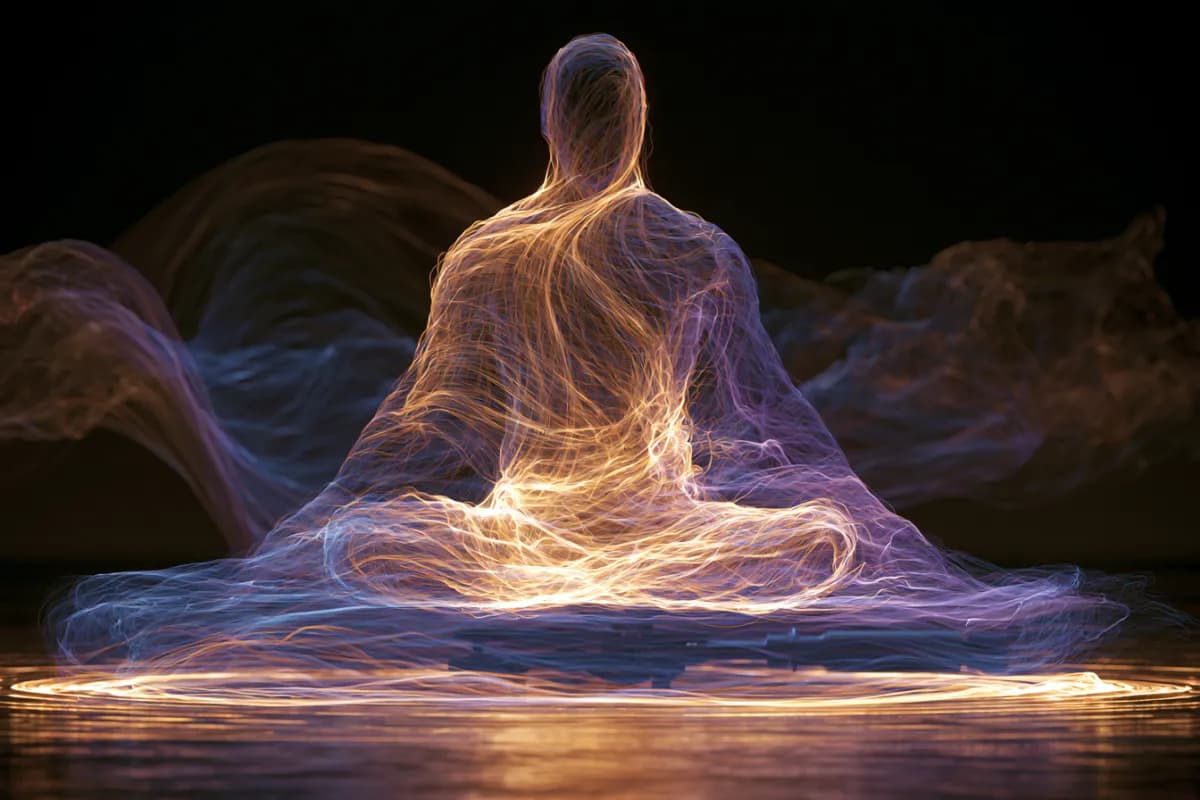
Prana was basically a big black box. A chair in front, a screen on top. You sit in the chair, and it shows the energy coming out of your body on the screen.
And before you roll your eyes — no, this is not spiritual nonsense. It's actual physics. Every living thing leaks energy, every second. Your body gives off heat; that's what a thermal camera sees. Your heart makes an electromagnetic field that reaches almost a metre outside your body. And sixty years ago, a German scientist found that every living cell also gives off a tiny bit of light — far too faint for our eyes. Basically, we are all glowing, all the time. We're just too dim to notice. Prana was the eye that could finally see that glow.
My colleague Meera was my first "guinea pig," as she called it, laughing, as she sat in the chair. On the screen, a calm golden light spread around her — smooth, steady. "Now think of something that makes you angry," I said. She closed her eyes, and the gold broke apart. Red spikes shot out like thorns, the whole thing trembling and going cold at the edges.
Change the emotion, change the shape. Good feelings: warm, steady, together. Bad feelings: scattered, cold, sharp. That day I understood something. When people say "positive energy" and "negative energy," it isn't just poetry from your yoga aunty. It's a shape. And you can measure it.
---
The next day I finally tested the question I'd carried for twenty years. Music. First I played an ugly, harsh noise near Meera — metal scraping metal. Her light shattered instantly. Cold, sharp. Then I switched it off and played an Ilaiyaraaja tune.
For a few seconds, nothing. Then, slowly, the sharp edges softened. The red faded and the gold came back. The light stopped shaking and began to rise and fall gently, like waves, matching the rhythm of the song. Her breathing, her heartbeat, every vibration in her body was tuning itself to the music.
I just stood there, staring at the screen. Twenty years ago, on a highway at midnight, the exact same thing had happened to me. A tune had put a broken mind back together. Back then, I only felt it. Now I was watching it happen, in colour. The question I'd built this whole machine to answer — I finally had my answer.
---
But that same evening, Prana showed me something that shook me. When I scanned Meera for longer, there was a spot on her stomach — nothing to do with any emotion — that was cold, still, completely dark. Everywhere else glowed. That one place was dead.
"Meera, get your stomach scanned tomorrow. Just do it. Don't ask me why." Ten days later she walked into my lab with no colour left on her face. "Early tumour. Pancreas. They said if I'd caught it a little later…" She couldn't finish the sentence. My machine had seen a disease before there was a single symptom. Sick cells lose their light.
---
Over the next few weeks I found something deeper. These fields talk to each other. I filmed two men having an argument. One man's red, scattered light spread out like ripples and touched the other's — and where it touched, the second man's light started turning red and shaking too. Negative energy, jumping from one person to another. Measurable.
The opposite was also true. I sat a very calm old man next to a nervous student. Within minutes, the old man's steady golden glow wrapped around the boy and settled his shaking — like one candle lighting another. You know how some people leave you drained and some leave you lighter? Turns out that's not your imagination. And your grandmother saying "don't go to that house, the energy there is bad"? Not superstition. She was reading it without any machine — with just her own body.
---
After Meera's surgery went well, a question started eating at me. Death had come that close. All this time I'd been measuring strangers in my lab. What did the light of the people closest to me look like?
For three years, home had been just a place to sleep. That day I went back early. My son Kannan is six now. He looked up when I walked in — but he didn't run to me. He hesitated, then went back to his toys. That hesitation stayed with me all night.
The next day I brought my wife Malathi and Kannan to the lab. Malathi sat in the chair. I looked at the screen and froze. Her light was grey. Tired, dim, shrunk small. There was a time I thought her smile could light up a whole room. That light was gone. Then I sat Kannan down. A six-year-old's light should be bright, bouncing everywhere. His was small, curled into itself, waiting — the light of a child who has learned to expect someone to get angry.
Slowly, a horrible truth dawned on me. What had I been carrying into that house for three years? Exhaustion. Stress. Silence. I had seen it with my own machine — how negative energy spreads, one person's broken light breaking the people around them. The darkness I brought home every day had been quietly dimming my wife and my son. I was busy measuring strangers' light while my own home went dark, because of me.
The music, by the way, never left my ears. But somewhere along the way it had left my house. There was a time our home was always full of songs. In our early days, Malathi and I danced to them on the terrace. When Kannan was born, I hummed those same tunes to put him to sleep. Then work got big, and the music shrank into my head alone — into my earphones, in private. It stopped playing out loud. Nobody hummed together anymore. Silence moved into the space where the music used to be. Every single night I was still listening. I just never noticed I'd stopped sharing it with anyone.
---
The next day I decided to fix it, using the one thing I knew worked — music, and being there. I came home early to say sorry, to start again. But the house was quiet.
The cupboard stood half open, half empty. Kannan's corner, where his toys used to be, was wiped clean. And on the dining table lay the house key — the one Malathi always kept knotted in the end of her saree. She'd left it there. No note. Nothing written. Nothing needed to be. The key said everything.
I stood there a long time. Then, out of pure habit, I took my handheld scanner and scanned the empty room. On the screen, faintly, some light still lingered — the leftover glow of years of love and laughter and lullabies that had lived in those walls. But it wasn't staying. It was drifting slowly toward the door, moving out. Energy is never destroyed, physics says. It only changes place. The light of that house hadn't gone out. It had simply packed up and left, with the people who loved me, for some other home.
I sat alone in that empty room with my own dim light. Very softly, to myself, I tried to hum the line that had saved me twenty years ago. "Naan thedum sevanthi poo idhu…" But my voice broke on the second line. In that empty room, it refused to come out. Twenty years ago, that same line, in a stranger's voice, had given me my life back. Today, in my own voice, it wouldn't even leave my throat.
I built an eye to see the light in every living thing — and I missed the only light that mattered. My own home, going a little darker each day, right in front of me. I measured everyone's glow. The people sitting closest to me were the only ones I never looked at.
A song can save a life. I know that better than anyone. But it has to play at the right time. And for some of us, that time has already passed.