Micron and ASML: The Two Companies That AI Physically Cannot Happen Without

If you drew a picture of the AI supply chain from the top down, it would look like a triangle. At the top: OpenAI, Anthropic, Google — the model companies everyone talks about. In the middle: Nvidia, AMD, Broadcom — the chip designers we spent last week talking about. At the bottom, holding all of it up: two companies almost nobody at a dinner party has heard of.
Micron makes memory. Specifically, HBM (High Bandwidth Memory) — the tightly-stacked memory that sits next to every AI training chip on the planet. Without HBM, GPUs can't feed themselves fast enough to train models. Micron is one of three companies globally that can make it at scale.
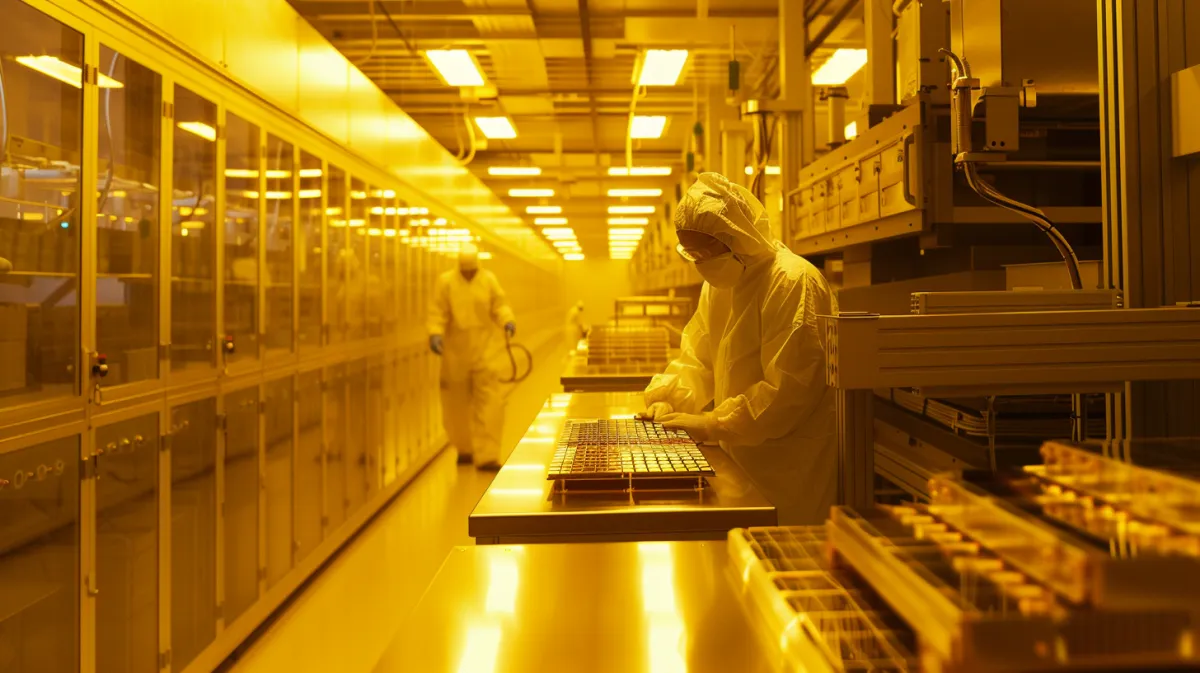
ASML makes the machines that print the chips themselves. Every leading-edge semiconductor manufactured after 2020 — Nvidia H100, Apple M4, AMD MI350, everything — was printed on an ASML EUV lithography machine. ASML is the only company in the world that makes these machines. Not "the best." The only.
This post is why I'm buying both — and why $10 a week into these two companies is arguably the most direct way to own the AI capex cycle by 2030.
Meet the physical chokepoints
Micron (MU) is a memory manufacturer headquartered in Boise, Idaho. Founded 1978. Makes DRAM (main system memory), NAND (flash storage), and — critically for our story — HBM. If AI is a car, HBM is the fuel line. Without it, the engine starves.
ASML is a Dutch company in Veldhoven, Netherlands. It makes the extreme ultraviolet lithography machines that print modern chips. Each machine costs around $250 million. The next-generation High-NA versions cost $400 million each. Every advanced fab on Earth — TSMC, Samsung, Intel, SMIC — buys ASML machines because there is literally no alternative.
Neither company designs an AI product. Neither hires a "prompt engineer." Both are absolutely central to whether AI happens at all.
Micron — the quarter that broke the memory industry
Micron's Q3 fiscal 2026 print, in June 2026, is one of the more remarkable earnings numbers in semiconductor history.
Revenue: $41.46 billion — up 346% year over year and 74% quarter over quarter. Q3 generated $25.39 billion of operating cash flow. This is a memory company. Memory companies are supposed to be cyclical, boring, and margin-thin. Micron just posted the numbers of an AI hardware startup.
Two things drove it. First, HBM demand for AI. Second, HBM is fully sold out through 2027. Every wafer Micron will produce for the next 18 months is already spoken for. That gives the company something no memory company has ever had: pricing power.
Micron also disclosed ~$22 billion in financial commitments with ~$100 billion in contracted multi-year revenue. That's forward visibility that most tech companies would kill for.
Stock: around $920 after a ~700% run over the past twelve months. Absolutely not cheap. But priced for a business that has fundamentally changed.
The bear case: memory has always been cyclical. If HBM production ramps too fast in 2027-2028 and competing suppliers (SK hynix, Samsung) flood the market, prices could crater and margins compress in ways Micron shareholders have not felt in years.
The bull case: HBM is genuinely constrained by physics, packaging know-how, and capex. Micron has one of only three viable HBM4 stacks. If AI training demand compounds — even at half the current rate — HBM stays scarce through 2028 and the price power stays.
ASML — the one-company monopoly nobody talks about
ASML's Q1 2026 print was more boring than Micron's, but the story underneath is stranger.
Net sales: €8.8 billion, beat consensus by €100M. EPS $8.37 vs $7.72 forecast. Full-year 2026 guidance raised to €36-40 billion. Gross margin: 53% — enormous for a hardware company. EUV system sales alone: €4.1 billion in the quarter, including revenue from two of the new High-NA machines.
Here's the punchline that the market keeps under-weighting: memory customers accounted for 51% of net system sales in Q1. Meaning DRAM makers — Micron, SK hynix, Samsung — are now buying EUV machines to keep up with HBM demand. The two companies I'm talking about in this post are literally each other's customers.
Stock: around $780, down 6% after the earnings print on China export concerns. But the underlying order book is at multi-year highs, and TSMC's roadmap for 3nm and 2nm nodes is entirely dependent on ASML machines that haven't shipped yet.
The bear case for ASML: China. The U.S. and Netherlands have progressively restricted ASML sales to Chinese customers. If restrictions expand or China accelerates domestic EUV development, ASML loses ~15-20% of its addressable market.
The bull case: even without China, the global EUV order book is oversubscribed. TSMC alone will spend $60 billion on capex in 2026, most of it flowing to ASML. The multi-hundred-million-dollar machines take 18 months to build. There is no alternative supplier. The moat isn't a moat — it's a physical impossibility for competitors.
⭐ What $10, $25, or $50 a week becomes by December 2030
Ground rules. Start next Friday. Split whatever you commit 50/50 between MU and ASML. Buy fractional shares every Friday. Stop December 26, 2030. 225 Fridays of not touching the account.
The three scenarios.
- Bear — memory cycle turns hard, China restrictions squeeze ASML further. MU drifts to $700. ASML to $700.
$10 a week — $4,500 total in over four and a half years.
| Scenario | End portfolio value | Return |
|---|---|---|
| Bear | ~$4,100 | −9% |
| Base | ~$5,400 | +21% |
| Bull | ~$6,300 | +40% |
In layman terms.
What could break this
Memory cycles are real. Micron's price power stops the moment a competitor floods the market with cheap HBM. This has happened before in the industry — 2019, 2022 — and it's the single biggest risk to the base case for MU.
China accelerates domestic lithography. If SMIC or a Chinese state-backed program produces working 7nm-equivalent lithography without ASML machines by 2028, ASML's addressable market shrinks by 15-20% and its stock re-rates lower.
AI capex peaks. Both stocks are ultimately downstream of the AI training capex cycle. If OpenAI, Anthropic, Google, and Meta all cut infrastructure spending by 30% because AI adoption stalls, the base case turns into the bear case for both.
I stop DCA and reassess if any of those actually happen.
The reflection
The most durable investment thesis in tech is usually "who can't be replaced." Not "who is fastest growing." Not "who has the best product." Who cannot be swapped out without breaking the entire supply chain.
Micron isn't literally irreplaceable — SK hynix and Samsung also make HBM. But if Micron went offline tomorrow, hyperscaler AI training would slow to a crawl for 12-18 months.
ASML is literally irreplaceable. Full stop. There is no alternative. Every leading-edge fab on Earth is dependent on machines that only one Dutch company knows how to build. That's not a moat. That's a physical property of the universe.
If you believe that AI compute demand keeps compounding for the rest of the decade — even at half the pace of the last two years — the picks-and-shovels layer keeps getting paid. Not because it's exciting. Because the entire pyramid rests on it.
Skip a coffee. Buy the chokepoint. See you in 2030.
---
This is not financial advice. I own both MU and ASML. I'm sharing my personal research and strategy. Past performance and price projections are not guarantees. Always do your own due diligence before investing.